Mnemonics in part is created by similar sounds. I found this website http://www.rhymezone.com/ helpful for creating similar sounds such as Thyer-Martin = Thigh-er Martyr mnemonics that I've made.
Comparison of two culture media types used to grow Neisseria gonorrhoeae bacteria.
Known as overgrowth, note that the non-selective chocolate agar medium on the left, due to its composition, allowed for the growth of organismal colonies other than those of Neisseria gonorrhoeae,
while the selective Thayer-Martin medium on the right, containing
antimicrobials that inhibit the growth of organisms other than N. gonorrhoeae, shows no overgrowth, but is positive for N. gonorrhoeae bacteria.
Thayer-Martin agar (or Thayer-Martin medium) is a Mueller-Hinton agar with 5% chocolate sheep blood and antibiotics. It is used for culturing and primarily isolating pathogenic Neisseriabacteria, including Neisseria gonorrhoeae and Neisseria meningitidis, as the medium inhibits the growth of most other microorganisms. When growing Neisseria meningitidis, one usually starts with a normally sterile body fluid (blood or CSF), so a plain chocolate agar is used. Thayer-Martin agar was initially developed in 1964, with an improved formulation published in 1966.[1][2][3]
Components
It usually contains the following combination of antibiotics, called VCN inhibitor
Colistin, which is added to kill most Gram-negative organisms except Neisseria, although some other Gram-negative organisms such as Legionella are also resistant
Mnemonics: Thayer-Martin = Thigh-er Martyr = a martyr who keeps trying to get in the thighs of ppl = Gonorrhea selected (selective!) - (Reproduction okay with credits to npprep.blogspot.com)
Varicocele = Varicose eel = Due to varicose veins leading to eels (worms) in the skinny bag (aka scrotum) = bag of worms ~by Qt (Reproduction okay with credits to npprep.blogspot.com)
Visit every 2 months:
@2mo: 2 B DR. HIP (@ 2mo: HepB, DTaP, Rotavirus, Hib, IPV, PCV)
@4mo: 4 DR. HIP (@4mo: DTap, Rotavirus, IPV, PCV)
@6mo: B DR. HIP In 6mo (HepB, Dtap, Rotavirus, Influenza, PCV in 6mo)
4-6yo: VERY DIM between 4-6pm (Varicella, Dtap, IPV, MMR)
11-12yo: Tada! Human! Men! (TdaP, HPV, Meningoccocal)
16-18yo: Men get boosted!
Legend:
B: Hep B
D: DTaP
R: Rotavirus
H: Hib
I: IPV
P: PCV
M: MMR
A: HepA
V or Very: Varicella
Tada: TdaP
Human: HPV
Men: MCV
NOTE for California elementary school entry: (by Qt)
Hep B: needs 3 doses (Mnemonics: Hep B = B = Bday = given at Birth, then 2 mo. later, than 4 mo. later (@ birth, 2,6 = 3 doses)
DTaP: needs 5 doses (DR HIP, DR HIP, DR HIP, MAD HPV, & Very DIM)
IPV: needs 4 doses (DR HIP, DR HIP, DR HIP, & Very DIM)
Varicella & MMR: needs 2 doses (Varicella & MMR: live vaccines = must be given after 1 yo (@12mo & @5yo generally speaking)
MCV & HPV: not given until middle school generally
Misc notes (Vax not required for school):
Influenze not given until 6mo and older
R = Rotavirus = only given at very young age, during first few initial visits (@2,4,6mo)
HepA = given @ 1 MAD HPV
Mnemonics: Prehn's sign = Positive = ePididymitis= Pull the testicle up = Pain Passed away ~by Qt (Reproduction okay with credits for npprep.blogspot.com)
----- Wiki: Prehn's sign (named after urologist Douglas T. Prehn)[1] is a medical diagnostic indicator that was once believed to help determine whether the presenting testicular pain is caused by acute epididymitis or from testicular torsion.[2]
Although elevation of the scrotum when differentiating epididymitis
from testicular torsion is of clinical value, Prehn's sign has been
shown to be inferior to Doppler ultrasound to rule out testicular
torsion.[3]
According to Prehn's sign, the physical lifting of the testicles
relieves the pain of epididymitis but not pain caused by testicular
torsion.[4]
Negative Prehn's sign indicates no pain relief with lifting the
affected testicle, which points towards testicular torsion which is a
surgical emergency and must be relieved within 6 hours.
Another way to differentiate between epididymitis and torsion on physical examination is checking for the cremaster reflex
which is absent in the case of torsion.{current sources indicates
cremaster reflex to be present in both torsion and epididymitis: http://www.aafp.org/afp/2009/0401/p583.html}
Positive Prehn's sign indicates there is pain relief with lifting the affected testicle, which points towards epididymitis.
Graphic as a way to memorize, sorry if it seems vulgar. thanks
MALE GENITAL DEVELOPMENT: Tanner 1 - First (prepubertal) stage has no genital development Tanner 2 - 2 enlarged testicles Tanner 3 - Penis elongates (viz: the tip of the penis elongates as the the shape of the mid point of the letter '3' looking sideway) Tanner 4 - Penis increases in girth (Viz: #4 has a little more girth than previous #'s) Tanner 5 - adult state
FEMALE BREAST DEVELOPMENT: Beginning with Tanner 2, you simply spell out the word breast (BR-EA-S-T) Tanner 1 Prepubertal stage Tanner 2 BReast lumps or breast buds Tanner 3 Elevation (or Enlargement) of the areola so that breast and areola continue to grow as 1 mound Tanner 4 Separation of the the breast tissue mounds ast eh areola becomes a smaller mound on top of the larger breast mound tanner 5 Total breast development - adult-sized breasts & completed breast growth
PUBIC HAIR DEVELOPMENT: (same as male & female) Tanner 1: Prepubertal; no pubic hair Tanner 2: Viz just 2 little hairs, very fine, with few, if any, curls Tanner 3: Dark, coarse, curly hairs viz curly 3s Tanner 4: Viz the triangle in #4 completely filled iwth black Tanner 5: Viz Roman numeral 'V', with hair spreading laterally onto the medial aspects of the thighs
~By Qt (collected and revised from internet) (Copy okay with credits)
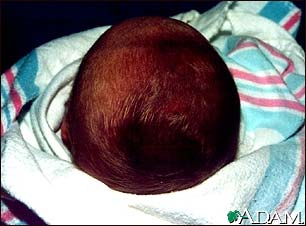
Caput succedaneum is swelling
of the scalp in a newborn. It is most often brought on by pressure from
the uterus or vaginal wall during a head-first (vertex) delivery.
Causes
A
caput succedaneum is more likely to form during a long or hard
delivery. It is more common after the membranes have broken. This is
because the fluid in the amniotic sac is no longer providing a cushion
for the baby's head. Vacuum extraction done during a difficult birth can
also increase the chances of a caput succedaneum. A
caput succedaneum may be detected by prenatal ultrasound, even before
labor or delivery begins. It has been found as early as 31 weeks of
pregnancy. Very often, this is due to an early rupture of the membranes
or too little amniotic fluid. It is less likely that a caput will form
if the membranes stay intact.
Updated by: Neil
K. Kaneshiro, MD, MHA, Clinical Assistant Professor of Pediatrics,
University of Washington School of Medicine, Seattle, WA. Also reviewed
by David Zieve, MD, MHA, Medical Director, Brenda Conaway, Editorial
Director, and the A.D.A.M. Editorial team.
This blog claims no credit for any images posted on this site unless otherwise noted. If there is an image appearing on this blog that belongs to you and you do not wish for it appear on this site, please let me know and it will be promptly removed. *All cases are fictitious. No real patient encounters. Any resemblance to real persons, living or dead, is purely coincidental.* Material on this blog is provided for informational purposes only. It is not a substitute for medical care, rehabilitation, educational, consultation, or legal advice. Information on this blog is general as it cannot address each individual’s situation and needs. This blog contains general information which may or may not apply to individuals. This blog cannot and does not address each individual’s situation and needs. I encourage everybody to seek professional advice for any specific questions and concerns. I have made every effort to insure that content is accurate, correct and current and am NOT liable for ANY errors. Images are linked to their websites, please click on the images to be navigated to their original sources. Links to other Websites and contacts have been carefully chosen, but do not imply endorsement and I am NOT responsible or liable for their information and contents. Under NO circumstances, shall the authors and publishers be liable under any theory of recovery for any damages arising out of or in any manner connected with the use of information, services, or documents from the site. Thank you!!!
Quote:
Understanding is key to confidence. Practice helps with psychomotor skills. ~by Qt
Sexy doesn’t impress me. Smart impresses me, strength of character impresses me. But most of all, I am impressed by kindness. Kindness, I think, comes from learning hard lessons well, from falling and picking yourself up. It comes from surviving failure and loss. It implies an understanding of the human condition, forgives its many flaws and quirks. When I see that in someone, it fills me with admiration. ~L.U.








 A
caput succedaneum may be detected by prenatal ultrasound, even before
labor or delivery begins. It has been found as early as 31 weeks of
pregnancy. Very often, this is due to an early rupture of the membranes
or too little amniotic fluid. It is less likely that a caput will form
if the membranes stay intact.
A
caput succedaneum may be detected by prenatal ultrasound, even before
labor or delivery begins. It has been found as early as 31 weeks of
pregnancy. Very often, this is due to an early rupture of the membranes
or too little amniotic fluid. It is less likely that a caput will form
if the membranes stay intact.

