Sinus headache
Introduction
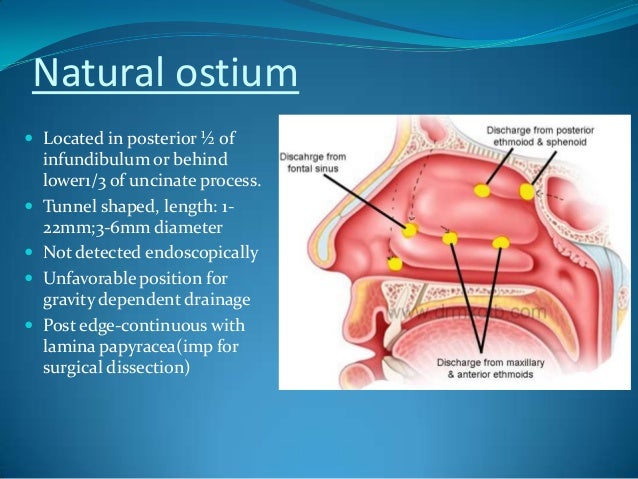
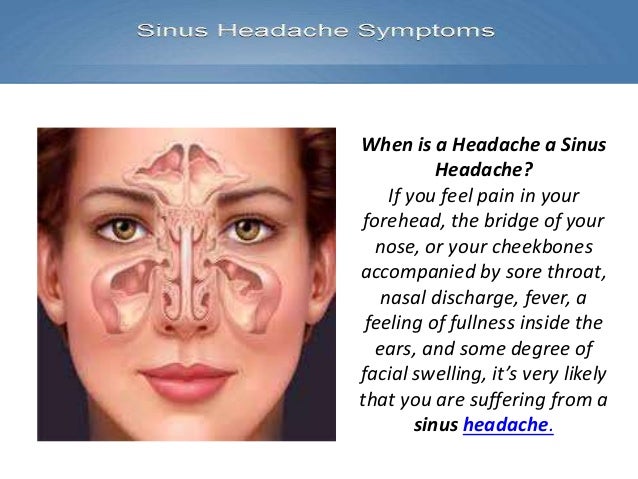
Sinus headaches cause a dull, deep,
throbbing pain in the front of your head and face. They are caused by
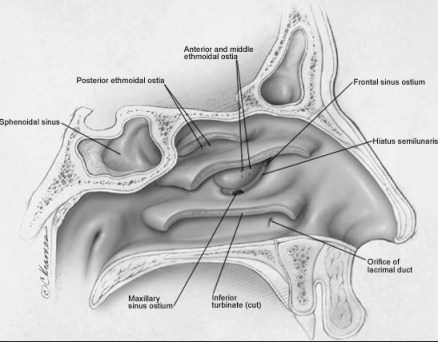
an inflammation in your sinuses, air-filled cavities around your nose,
eyes, and cheeks. Bending down or leaning over usually makes the pain
worse, as does cold and damp weather.
Sinus headaches often begin
first thing in the morning, and may be better by afternoon. Sinus
headaches can be difficult to diagnose, however, because symptoms are
similar to tension headaches and migraines.
Signs and Symptoms
Sinus headaches typically have the following symptoms:
- Pressure-like pain in one specific area of your face or head (for example, behind your eyes)
- Face is tender to the touch
- Pain is worse with sudden movements of the head and bending forward
- Pain is worse in the morning because mucus collects and drains through the night
- Sudden temperature changes, like going out into the cold from a warm room, worsen the pain
- Headache often starts when you have a bad cold or just after
- Congested or runny nose
Other symptoms may be related to sinus inflammation (sinusitis):
- Fever
- Postnasal drip with sore throat (pharyngitis)
- Yellow or green discharge from your nose
- Red and swollen nasal passages (nasal congestion)
- Mild-to-moderate fever
- A sense of not feeling well
- Fatigue
- Pain in upper teeth
Migraines
may feel worse when you bend forward and can be accompanied by nasal
congestion. But a migraine is more likely to be made worse by noise or
light, and to be accompanied by nausea.
Causes
Sinus
headaches can be caused by sinus congestion and inflammation, called
sinusitis. Sinusitis, in turn, is caused by either a respiratory
infection, such as a cold or flu, or allergies, like hay fever.
Healthy
sinuses allow mucus to drain and air to circulate throughout the nasal
passages. When sinuses become inflamed, these areas get blocked and
mucus cannot drain. When sinuses are blocked, they provide a place for
bacteria, viruses, and fungus to live and grow rapidly. Although a cold
is the most common culprit, sinusitis can be caused by anything that
prevents the sinuses from draining.
Risk Factors
- History of allergies, especially hay fever, or asthma
- Nasal polyps or swellings in the nasal passage, nasal bone spurs, nasal or facial tumor, deviated septum, or cleft palate
- Climbing or flying to high altitudes
- Frequent swimming or diving
Diagnosis
Your
doctor will ask questions to distinguish sinus headaches from migraines
or tension headaches. If you have had a recent cold, allergy flare up,
or symptoms of sinusitis, it will help your doctor make a diagnosis.
Your
doctor will look in your nose to check for congestion and nasal
discharge. Your doctor will also press on areas of your face to check
for tenderness. Your doctor may shine a light through the sinuses to
look for sinus inflammation; if the light does not shine through, your
sinuses may be congested.
If your doctor suspects chronic
sinusitis, you may need imaging tests, including an x-ray, computed
tomography (CT) scan, or magnetic resonance imaging (MRI). If your
doctor suspects allergies may be causing your sinusitis, you may need an
allergy test. Your doctor may also refer you to a specialist, known as
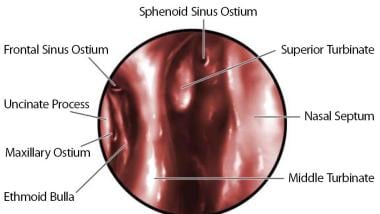
an ear, nose and throat (ENT) doctor, or an otolaryngologist. This
specialist may perform a nasal endoscopy using a fiber optic scope to
look at your sinuses.
Treatment Approach
The
best way to avoid or get rid of a sinus headache is to treat the
underlying sinus inflammation. Sinus pain caused by allergies may be
helped by allergy medications and medicated nasal sprays. Your doctor
may prescribe antibiotics or corticosteroids. Lifestyle changes, such as
using a humidifier or irrigating your nasal passages with salt water,
may also help. Several dietary supplements and herbs may help prevent
colds and flu, shorten their duration, or work together with antibiotics
to treat your infection and support your immune system. Flushing the
nose and sinuses with saline solution may also help.
Lifestyle
Doing the following things can help reduce congestion in your sinuses:
- Using a humidifier
- Using a saline nasal spray
- Breathing in steam 2 to 4 times per day (for example, sitting in the bathroom with the shower running)
- Quickly treating allergic and asthma attacks
Other techniques that might help include:
- Stretches for the head and neck
- Relaxation techniques (see Mind-Body Medicine section)
Medications
Antibiotics.
Your doctor may prescribe antibiotics if they suspects you have a
bacterial infection. To treat acute sinusitis, you may take from 10 to
14 days of antibiotics. Treating chronic sinusitis may take longer,
usually 3 to 4 weeks.
Nasal corticosteroids.
These prescription sprays reduce inflammation of the nose and help
relieve sneezing, itching, and runny nose. They are most effective at
reducing symptoms, although it can take anywhere from a few days to a
week after you start using them to see improvement.
- Beclomethasone (Beconase)
- Fluticasone (Flonase)
- Mometasone (Nasonex)
- Triamcinolone (Nasacort)
Antihistamines.
Antihistamines are available in both oral and nasal spray forms, and as
prescription drugs and over-the-counter remedies, to treat allergies.
Over-the-counter antihistamines are short acting and can relieve
mild-to-moderate symptoms. All work by blocking the release of histamine
in your body.
- Over-the-counter antihistamines: Include
diphenhydramine (Benadryl), chlorpheniramine (Chlor-Trimeton), and
clemastine (Tavist). These older antihistamines can cause sleepiness.
Fexofenadine (Allegra), cetinzine (Zyrtec), and loratadine (Claritin)
are newer antihistamines that do not cause as much drowsiness.
Decongestants.
Many over-the-counter and prescription decongestants are available in
tablet or nasal spray form. They are often used in combination with
antihistamines.
- Oral and nasal decongestants: Include
Sudafed, Actifed, Afrin, and Neo-Synephrine. Some decongestants may
contain pseudoephedrine, which can raise blood pressure. People with
high blood pressure or enlarged prostate should not take drugs
containing pseudoephedrine. Avoid using nasal decongestants for more
than 3 days in a row, unless specifically instructed by your doctor,
because they can cause rebound congestion. Do not use them if you have
emphysema or chronic bronchitis.
Triptans.
In one study, 82% of people with sinus headaches had a significant
response to triptans, a medication commonly used for migraines.
Surgery and Other Procedures
For
chronic sinusitis that does not respond to medication, your doctor may
recommend endoscopic sinus surgery, which may be done to remove polyps
or bone spurs. Some doctors also recommend enlarging the sinus opening. A
newer procedure called balloon rhinoplasty involves inserting a balloon
inside the sinus cavity and then inflating it.
Sinus surgeries are done by an ENT specialist.
Nutrition and Dietary Supplements
Several
supplements may help prevent or treat sinus headaches, either by
reducing sinus inflammation, or by helping to ward off colds. (See
Sinusitis for more details.) Because supplements may have side effects,
or interact with medications, you should take them only under the
supervision of a knowledgeable health care provider.
- Bromelain.
Several studies suggest that bromelain, an enzyme derived from
pineapples, may help reduce inflammation and swelling and relieve
symptoms of sinusitis. However, not all studies agree. Bromelain is
often combined with quercetin, a flavonoid or plant pigment responsible
for the colors found in fruits and vegetables, which may act as an
antihistamine. Bromelain may increase the risk of bleeding, so people
who take blood thinners, such as warfarin (Coumadin) or clopidogrel
(Plavix) should not take bromelain without talking to their doctor
first. Taking bromelain with ACE inhibitors may cause a drop in blood
pressure, called hypotension. Bromelain may interact with certain
antibiotics as well. Speak with your doctor.
- Quercetin.
In test tubes, quercetin stops the production and release of histamine,
which causes allergy symptoms, such as a runny nose and watery eyes. It
is often combined with bromelain. However, there is not yet much
evidence that quercetin would work the same way in humans. More studies
are needed. Some people may prefer water-soluble forms of quercetin,
such as hesperidin methyl chalcone (HMC) or quercetin chalcone.
Quercetin may interact with certain medications, so ask your doctor
before taking it.
- Probiotics (Lactobacillus).
Probiotics, or "friendly" bacteria, may help if you are taking
antibiotics for sinusitis. They may also reduce your chances of
developing allergies. People who have very weakened immune systems or
who take drugs to suppress the immune system should ask their doctor
before taking probiotics.
Herbs
The use of herbs is
a time-honored approach to strengthening the body and treating disease.
Herbs, however, can trigger side effects and can interact with other
herbs, supplements, or medications. For these reasons, you should take
herbs with care, under the supervision of a health care practitioner.
As
with supplements, there are many herbs that may help reduce your
chances of getting a sinus headache by preventing or treating a cold,
boosting your immune system, or reducing sinus inflammation.
Sinupret, a proprietary formulation containing European elder (
Sambucus nigra), common sorrel (
Rumex acetosa), cowslip (
Primula veris), European vervain (
Verbena officinalis), and gentian (
Gentiana lutea).
In two studies, Sinupret was found to work better than placebo in
relieving symptoms of sinusitis. The herbs it contains may work by
thinning mucus and helping the sinuses drain, and they may also help
strengthen the immune system.
Although research is lacking, other herbs have been used traditionally to treat headaches:
- Chinese skullcap (Scutellaria baicalensis)
- Feverfew (Tanacetum parthenium)
- Willow bark (Salix spp.)
People
who take blood thinners, or women who are pregnant or breastfeeding,
should not take these herbs. People who are allergic to aspirin should
not take willow bark. Feverfew can interact with several medications. If
you are allergic to ragweed you may also be allergic to feverfew.
Homeopathy
One
of the most common reasons people seek homeopathic care is to relieve
chronic headaches. Few studies have examined the effectiveness of
specific homeopathic remedies. Professional homeopaths, however, may
recommend treatments for sinus headaches based on their knowledge and
clinical experience. In one study of homeopathy for sinusitis, more than
80% of the participants had significant improvement in their symptoms
after taking the homeopathic remedy for 2 weeks.
Before
prescribing a remedy, homeopaths take into account a person's
constitutional type. In homeopathic terms, a person's constitution is
his or her physical, emotional, and intellectual makeup. An experienced
homeopath assesses all of these factors when determining the most
appropriate remedy for a particular individual.
The following are remedies commonly prescribed for sinus congestion and headache:
- Arsenicum album. For throbbing, burning sinus pain that is relieved by lying upright in a cool room with open windows.
- Belladonna.
For throbbing headaches that come on suddenly and feel worse with
motion and light; pain is partially relieved by pressure, standing,
sitting, or leaning backwards.
- Bryonia. For headaches
with a steady, sharp pain that occurs most often in the forehead but may
radiate to the back of the head; symptoms tend to worsen with movement
and light touch, but firm pressure alleviates the pain; the person for
whom this remedy is most appropriate is usually irritable and may
experience nausea, vomiting, and constipation.
- Hepar sulphuricum.
For headaches described as "a nail being driven between the eyes,"
these types of headaches are often accompanied by thick, yellow nasal
discharge; symptoms tend to worsen with movement and light touch of the
scalp and improve with pressure.
- Iris versicolor. For
throbbing headaches that occur on one side of the head, especially after
eating sweets; visual disturbances may also occur; these headaches are
worse in the early morning, during spring and fall, and symptoms tend to
worsen with vomiting.
- Kali bichromicum. For sinus
headaches and congestion; pain often occurs between and behind the eyes;
symptoms typically progress throughout the morning, worsen with cold
and motion, and improve with warmth and pressure.
- Mercurius.
For raw, swollen nostrils; this remedy is most appropriate for
individuals whose pain feels as though the head has been placed in a
vise; pain may also extend to the teeth; symptoms tend to worsen at
night and the individual may alternate between sweating and having the
chills; nasal discharge may be bloody.
- Natrum muriaticum. For headaches and congestion associated with allergies.
- Pulsatilla.
For headaches triggered by eating rich, fatty foods, particularly ice
cream; pain may move around the head but tends to be concentrated in the
forehead or on one side of the head and may be accompanied by digestive
problems or occur around the time of menstruation; symptoms tend to
worsen at night and with coughing and blowing the nose; children often
develop these symptoms while at school.
- Silicea. For sinus pain that improves with pressure, head wraps, and warm compresses.
- Spigelia.
For stinging, burning, or throbbing sinus pain that often occurs on the
left side of the head; symptoms tend to worsen with cold weather and
motion but may be temporarily relieved by cold compresses and lying on
the right side with the head propped up.
Acupuncture
Although
studies are few and have found conflicting results, some people may
find that acupuncture helps relieve symptoms of sinusitis. An
acupuncturist diagnosis headaches not as migraine, tension, or sinus,
but rather as conditions deriving from "energetic" imbalances.
Acupuncturists usually describe sinusitis as "dampness" which creates
inflammation and congestion in the mucus membranes. This dampness is
cleared by strengthening the spleen meridian and by working with the
stomach meridian. Practitioners often perform needling therapy and/or
moxibustion, a technique in which the herb mugwort is burned over
specific acupuncture points, for this condition.
Chiropractic
Although
there are no studies on using chiropractic to treat sinus headaches,
some practitioners suggest that it may decrease pain and improve sinus
drainage for some people.
Mind-Body Medicine
For headaches
in general, relaxation techniques can be helpful. This is especially
true for frequent headaches, such as sinus headaches. You may want to
try these techniques:
- Biofeedback to control muscle tension
- Learn to meditate, breathe deeply, or try other relaxation exercises, such as yoga or hypnotherapy
- Try guided imagery techniques
Other Considerations
If
you are not better in a few weeks, your primary care physician may send
you to see an ear, nose, and throat specialist for tests to find the
cause of your sinus congestion.
Pregnancy
Sinus congestion
often acts up during pregnancy. There are many herbs and medications
that pregnant and breastfeeding women should not use. Check with your
doctor before using any herbs or supplements if you are pregnant or
breastfeeding.
Warnings and Precautions
You should go to the emergency room or call 911 if you experience the following:
- Sudden and severe headache that persists or increases in intensity over 24 hours
- A sudden, severe headache that you describe as "your worst ever," even if you are prone to headaches
- Chronic or severe headaches that begin after age 50
- Headaches
accompanied by memory loss, confusion, loss of balance, change in
speech or vision, or loss of strength in, or numbness or tingling, in
any one of your limbs
- Headaches accompanied by fever, stiff neck, nausea, and vomiting (may indicate meningitis)
- Severe headache in one eye accompanied by redness of the eye (may indicate acute glaucoma)
Supporting Research
Annequin D, Tourniaire B, Massiou H. Migraine and headache in childhood and adolescence. Pediatr Clin North Am. 2000;47(3):617-31.
Aring AM, Chan MM. Acute rhinosinusitis in adults. Am Fam Physician. 2011 May 1;83(9):1057-63.
Blumenthal M, Goldberg A, Brinckmann J. Herbal Medicine: Expanded Commission E Monographs. Newton, MA: Integrative Medicine Communications; 2000:240-3.
Cady RK, Schreiber CP. Sinus headache or migraine? Considerations in making a differential diagnosis. Neurology. 2002;58(9 Suppl 6):S10-S14.
Foroughipour
M, Sharifian SM, Shoeibi A, Ehdali Barabad N, Bakhshaee M. Causes of
headache in patients with a primary diagnosis of sinus headache. Eur Arch Otorhinolaryngol. 2011;268(11):1593-6.
Friese
KH, Zabalotnyi DI. Homeopathy in acute rhinosinusitis: a double-blind,
placebo controlled study shows the efficiency and tolerability of a
homeopathic combination remedy. HNO. 2007;55(4):271-7.
Guo R, Canter PH, Ernst E. Herbal medicines for the treatment of rhinosinusitis: a systematic review. Otolaryngol Head Neck Surg. 2006;135(4):496-506.
Harvey R, Hannan SA, Badia L, Scadding G. Nasal saline irrigations for the symptoms of chronic rhinosinusitis. Cochrane Database Syst Rev. 2007;(3):CD006394.
Helms S, Miller A. Natural treatment of chronic rhinosinusitis. Altern Med Rev. 2006;11(3):196-207.
Kaya
A, Caliskan H. Does wet hair in cold weather cause sinus headache and
posterior eye pain? A possible mechanism through selective brain cooling
system. Med Hypotheses. 2012;79(6):744-5.
Kari E, DelGaudio JM. Treatment of sinus headache as migraine: the diagnostic utility of triptans. Laryngoscope. 2008;118(12):2235-9.
Karkos
PD, Leong SC, Arya AK, Papouliakos SM, Apostolidou MT, Issing WJ.
'Complementary ENT': a systematic review of commonly used supplements. J Laryngol Otol. 2007;121(8):779-82.
Marmura MJ, Silverstein SD. Headaches caused by nasal and paranasal sinus disease. Neurol Clin. 2014; 32(2):507-23.
Mauskop A. Alternative therapies in headache. Is there a role? Med Clin North Am. 2001;85(4):1077-84.
Mehle ME, Kremer PS. Sinus CT scan findings in "sinus headache" migraineurs. Headache. 2008;48(1):67-71.
Melzer
J, Saller R, Schapowal A, Brignoli R. Systematic review of clinical
data with BNO-101 (Sinupret) in the treatment of sinusitis. Forsch Komplement Med. 2006;13(2):78-87.
Alternative Names
Headache - sinus
Version Info
- Last reviewed on 10/19/2015
- Steven
D. Ehrlich, NMD, Solutions Acupuncture, a private practice specializing
in complementary and alternative medicine, Phoenix, AZ. Review provided
by VeriMed Healthcare Network. Also reviewed by the A.D.A.M. Editorial
team.
A.D.A.M., Inc. is accredited by URAC,
also known as the American Accreditation HealthCare Commission
(www.urac.org). URAC's accreditation program is an independent audit to
verify that A.D.A.M. follows rigorous standards of quality and
accountability. A.D.A.M. is among the first to achieve this important
distinction for online health information and services. Learn more about
A.D.A.M.'s editorial policy, editorial process and privacy policy.
A.D.A.M. is also a founding member of Hi-Ethics and subscribes to the
principles of the Health on the Net Foundation (
www.hon.ch)
The information provided herein should not be used during any medical
emergency or for the diagnosis or treatment of any medical condition. A
licensed medical professional should be consulted for diagnosis and
treatment of any and all medical conditions. Call 911 for all medical
emergencies. Links to other sites are provided for information only --
they do not constitute endorsements of those other sites. © 1997- 2013
A.D.A.M., Inc. Any duplication or distribution of the information
contained herein is strictly prohibited.