Showing posts with label Respiratory. Show all posts
Showing posts with label Respiratory. Show all posts


Pulmonary tuberculosis (TB) is caused by the bacterium Mycobacterium tuberculosis (M. tuberculosis). TB is contagious. This means the bacteria is easily spread from an infected person to someone else. You can get TB by breathing in air droplets from a cough or sneeze of an infected person. The resulting lung infection is called primary TB.
Most people recover from primary TB infection without further evidence of the disease. The infection may stay inactive (dormant) for years. In some people, it becomes active again (reactivates).
Most people who develop symptoms of a TB infection first became infected in the past. In some cases, the disease becomes active within weeks after the primary infection.
Source:https://medlineplus.gov/ency/article/000077.htm

Fibrotic scar in CXray may suggest an old TB that may stay dormant as the body immune system has enveloped the bacteria in one spot. The spot may still have the possibility to cause infection (latent TB). Therefore, ppl with 5mm TST should be treated for LITB
References: http://www.netwellness.org/question.cfm/82778.htm
Chlamydia is an STD. It's intimate => it's contracted in closed space such as dorm or jail
Mycoplasma = Michael place is small => closed space such as dorm or jail
~By Qt
Mycoplasma = Michael place is small => closed space such as dorm or jail
~By Qt
Hib => Betalactamase production (must use clavunate) => toBacco r/t dz
DRSP is a high scale thing, so need to use LeGeM (Levofloxacin, Gemifloxacin, Moxifloxacin) fluoroquinolones, may use HIGH amoxicillin, and that esoteric Telithromycin.
~by Qt
~by Qt
When I think about Macrolides, I think about 'Macklemore' singing the Thrift shop song which is good for everything (Chlamydia, Streptococcus, Mycoplasma, Haemophilius, and even the dreaded Legionella pneumonia). However, it ain't good for high-scale stuff like DRSP (Drug-resistant streptococcus Pneumoniae).
Also, remember that macrolides work on the ribosomes, therefore it ain't dependent on cell-wall. Thus, it works against small tiny bacteria such as Chlamydia & Mycoplasma.
Seriously, when we think of macrolides, we practically only use Z-Pack (azithromycin) as erythromycin has too much side effects and only useful for ointment.
~By Qt
Also, remember that macrolides work on the ribosomes, therefore it ain't dependent on cell-wall. Thus, it works against small tiny bacteria such as Chlamydia & Mycoplasma.
Seriously, when we think of macrolides, we practically only use Z-Pack (azithromycin) as erythromycin has too much side effects and only useful for ointment.
~By Qt
PNEUMONIA
CAP etiology: Strep. Pneumoniae most common, bacteria/virus
CAP: @ onset of dx, pt resides w/in commmunity, NOT in nursing home/other care facility, no recent (<2wks) hospitalization
CXR, No dx tests, Pretreatment blood culture, sputum. Severe: urinary antigen for Legionella & Strep.
Outpt Tx:
Empirical therapy:
A - Healthy pt (<60 y/o w/ no comorbidies): (Mac)
- Macrolide (azithromycin, clarithromycin, erythromycin)
- Doxycycline
B - Sick pt (>65 y/o, ca., heart/lung/liver/renal dz, ETOH, asplenia,immunosuppressed, ABX use w/in 3 mo.. ) (Queen)
- Resp. fluoroquinolone (moxifloxacin, gemifloxacin or levofloxacin) LeGeM
- Beta-lactam* plus a macrolide/doxycycline.
*Beta-lactam: High-dose amoxicillin, amoxicillin-clavunate, OR ceftriaxone, cefpodoxime, cefuroxime
Target therapy:
 |
| By Qt |
S.Pneumoniae:
- Non-resistant: macrolides, tetracyclines including doxycycline,select cephalosporins, standard dose amoxicillin
- DRSP (Drug-resitant Strep. Pneumoniea): respiratory fluoroquinolones, high-dose amoxicillin, telithromycin
H. influenza: beta-lactamase production (agents active against G- & stable in presence of or active aginast beta-lactamase).. Common pathogen for tobacco-related disease
- Tx: macrolides,tetracyclines including doxycycline, respiratory fluoroquinolones, cephalosporins, amoxicillin-clavulanate
Legionella spp: transmitted thru inhaling mist or aspirating liquid from contaminated water. No person-to-person spread. Severe PNA with diarrhea
- Tx: macrolides, tetracyclines including doxycycline, respiratory fluoroquinolones
- Ineffective: beta-lactams
C. pneumoniae, M. Pneumoniae (walking, tiny bacteria pneumonia): transmitted by cough in closed communities, e.g. correctional facilities, dorm, LTC.
- Tx: macrolides,,tetracyclines including doxycyclines, respiratory fluoroquinolones
- Ineffective: beta-lactams (these bacterias don’t have a huge cell wall)
~By Qt
http://www.cram.com/flashcards/np-review-respiratory-4774248
http://www.cram.com/flashcards/np-review-respiratory-4774248
COPD
I - COPD Classification
MM S V = M&M Super Vigorous COPD
Mild
Moderate
Severe
Very Severe

Assessment of COPD
Assessment of COPD
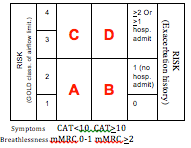
COPD treatment
A
|
SABA
|
SAMA
|
B
|
LABA
|
LAMA
|
C
|
ICS + LABA
|
ICS + LAMA
|
D
|
ICS + LABA
|
ICS+SABA+LAMA
|
SABA (Short Acting Beta Agonist): albuterol, levalbuterol (prn)
SAMA (Short Acting Muscarinic Antagonist): ipratropium, atrovent (prn or QID)
SA combo: Combivanet (albuterol + ipratropium)
LABA (Long Acting Beta Agonist): salmeterol, formoterol, arformoterol (BID). indacaterol (qd)
LAMA (Long Acting Muscarinc Antagonist): tiotropium (Spiriva), umeclidinium (Incruse), glycopyrrolate (Seebri), aclidinium (Tudorza) - qd or BID
LA combo: tiotropium + salmaterol (separate or combo); umeclidium+vilanterol (Anoro), glycopyrrolate+indacaterol (Utibron), ~By Qt
The CAT has 8 questions. Each question is assigned a value of from zero to five. And the score of each question is added so that scores can range from 0 to 40.

COPD Assessment Test
You can take the test online or print out a pdf copy of the test.*
Source: http://www.tomwademd.net/using-the-copd-assessment-test-to-follow-copd/
Source: https://www.verywell.com/guidelines-for-the-mmrc-dyspnea-scale-914740
The Modified Medical Research Council Dyspnea Scale - MMRC
The Modified Medical Research Council Dyspnea Scale, or MMRC, uses a simple grading system to assess a patient's level of dyspnea -- shortness of breath.
This scale doesn't define the sensation of breathlessness per se, but rather the degree of disability that such breathlessness poses on day-to-day activities.
The scale measures a broad range of disability due to dyspnea, from only mild limitations, up to severe limitations, and is an easy and rapid test to do.
In general, this scale correlates fairly well with objective measures of breathing such as pulmonary function tests and walk tests. It also tends to be stable over time which is good in having an objective measure.
MMRC Dyspnea Scale
| Grade | Description of Breathlessness |
|---|---|
| 0 | I only get breathless with strenuous exercise. |
| 1 | I get short of breath when hurrying on level ground or walking up a slight hill. |
| 2 | On level ground, I walk slower than people of the same age because of breathlessness or have to stop for breath when walking at my own pace. |
| 3 | I stop for breath after walking about 100 yards or after a few minutes on level ground. |
| 4 | I am too breathless to leave the house or I am breathless when dressing. |
Asthma:
I - Asthma Classification:
I’M M.S.
Intermittent
Mild Persistent
Moderate Persistent
Severe Persistent
S/s
|
SABA
|
Nite wake
|
FEV1
|
FEV1/ FVC
|
ADL limit
| |
I
|
<2/w
|
<2/wk
|
<2/m
|
>80%
|
Normal
|
None
|
M
|
>2/w
|
>2/w
|
3-4/m
|
>80%
|
Normal
|
Minor
|
M
|
qd
|
qd
|
>1s/w
|
60-80
|
red5%
|
Some
|
S
|
Thru day
|
times//d
|
7x/w
|
<60%
|
red>5
|
extreme
|
II - Asthma meds:
Number of controllers used in each stage of the classification of asthma - mnemonic:
I'M MS
12 34
I
|
1
|
SABA PRN (albuterol) only
|
M
|
2
|
Low dose ICS
|
M
|
3
|
(Low dose ICS + LABA) OR Med. ICS
|
S
|
4
|
Med. dose ICS + LABA
|
S
|
5
|
Hi dose ICS + LABA
& omalizumab for allergic pts
|
S
|
6
|
Hi dose ICS + LABA + oral steroids
&omalizumab for allergic pts
|
III - Asthma step up rule: rule of 2’s (if any, consider a daily controller med)
- Symptoms/SABA use: >2days/week
- Nighttime awakenings: >2x/month
- Exacerbations: >2x/year
- SABA replacement: 2 canisters/yr
~by Qt
If theFEV1/FVC ratio is <80%, it indicates that an obstructive defect is present.
Asthma is defined as a reversible obstructive defect. Therefore, a patient with an FEV1/FVC ratio < 80% can be given a bronchodilator (i.e. albuterol) and the spirometry can be repeated. If the FEV1 increases by more than 12%, it is indicative of reversible airway disease. If the FEV1 does not increase by more than 12%, it is considered nonreversible or fixed airway disease(i.e. COPD). Because asthma is a reversible obstructive defect, the spirometry may be normal at the time of evaluation. In instances where asthma is strongly considered yet the spirometry is normal, a methacholine challenge may be needed. In this test, a patient inhales one or more concentrations of methacholine, and results of spirometry before and after the inhalations are measured. The amount of methacholine needed to elicit a drop of 20% in the FEV1 (known as the PD20) is obtained. The lower the PD20, the more likely that the patient has reactive airways. The reader is directed elsewhere for a more complete review of methacholine testing.
Source: https://www.med.umich.edu/intmed/allergy/edu/syllabus/TOPICS/PFTs/fig5.htm
Figure 5 - Quick interpretation of spirometry
Asthma is defined as a reversible obstructive defect. Therefore, a patient with an FEV1/FVC ratio < 80% can be given a bronchodilator (i.e. albuterol) and the spirometry can be repeated. If the FEV1 increases by more than 12%, it is indicative of reversible airway disease. If the FEV1 does not increase by more than 12%, it is considered nonreversible or fixed airway disease(i.e. COPD). Because asthma is a reversible obstructive defect, the spirometry may be normal at the time of evaluation. In instances where asthma is strongly considered yet the spirometry is normal, a methacholine challenge may be needed. In this test, a patient inhales one or more concentrations of methacholine, and results of spirometry before and after the inhalations are measured. The amount of methacholine needed to elicit a drop of 20% in the FEV1 (known as the PD20) is obtained. The lower the PD20, the more likely that the patient has reactive airways. The reader is directed elsewhere for a more complete review of methacholine testing.
Source: https://www.med.umich.edu/intmed/allergy/edu/syllabus/TOPICS/PFTs/fig5.htm
Figure 5 - Quick interpretation of spirometry
- Are the patient's age, weight, and height correct?
- Is the effort acceptable? (based on lab technician comments and adequate volume time curve)
- Is an obstructive defect present (FEV1/FVC < 80%)
- If an obstructive defect is present, how severe is it
- FEV1 > 80% predicted = minimal
- FEV1 65 – 80% predicted = mild
- FEV1 50 - 65% predicted = moderate
- FEV1 < 50% = severe
- Does the shape of the curve suggest where the obstruction might be? (variable intrathroacic/extrathoracic, fixed)
- Is an early obstructive defect of the small airways present? (FEF 25-75 < 60%)
- Is a restrictive defect suggested? (FVC < 80% predicted
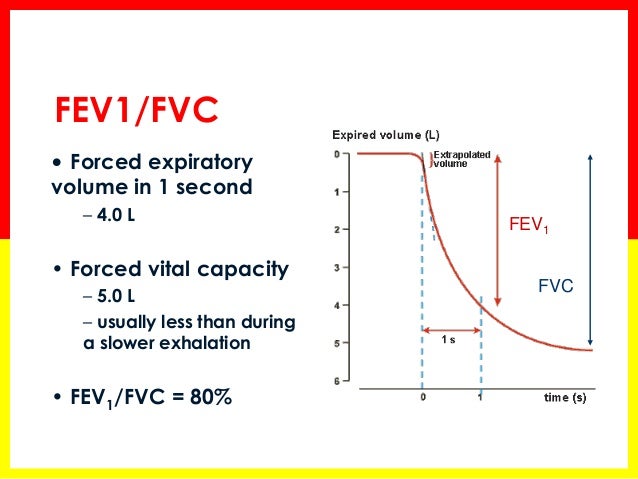
The FEV1/FVC ratio, also called Tiffeneau-Pinelli index,[1] is a calculated ratio used in the diagnosis of obstructive and restrictive lung disease.[2][3] It represents the proportion of a person's vital capacity that they are able to expire in the first second of forced expiration.[4]
Normal values are approximately 80%.[5] Predicted normal values can be calculated online and depend on age, sex, height, mass and ethnicity as well as the research study that they are based upon.
A derived value of FEV1% is FEV1% predicted, which is defined as FEV1% of the patient divided by the average FEV1% in the population for any person of similar age, sex and body composition.
Normal values are approximately 80%.[5] Predicted normal values can be calculated online and depend on age, sex, height, mass and ethnicity as well as the research study that they are based upon.
A derived value of FEV1% is FEV1% predicted, which is defined as FEV1% of the patient divided by the average FEV1% in the population for any person of similar age, sex and body composition.
FVC (forced vital capacity) is the volume of air that can be maximally forcefully exhaled - and therefore contains the FEV1 within it.

Classification of asthma - mnemonic
I'M MS ("I'm a Master of Science")
Intermittent
Mild persistent
Moderate persistent
Severe persistent
Number of controllers used in each stage of the classification of asthma - mnemonic:
I'M MS
0 1 2 3
0 - SABA PRN (albuterol) only
1 - ICS or LTRA
2 - ICS/LABA or ICS plus LTRA
3 - ICS/LABA and LTRA, consider omalizumab (anti-IgE mAb)
"Rule of 2s” is used to determine level of control. If any of these are positive, consider a daily controller medication:
- daytime symptoms more than 2 days/wk
- rescue β2 -agonist use more than 2 times per week
- nighttime symptoms more than 2 nights/mo
- more than 2 asthma exacerbations per year
- more than 2 rescue β2-agonist canisters/yr
- daytime symptoms more than 2 days/wk
- rescue β2 -agonist use more than 2 times per week
- nighttime symptoms more than 2 nights/mo
- more than 2 asthma exacerbations per year
- more than 2 rescue β2-agonist canisters/yr
References:
https://www.nhlbi.nih.gov/files/docs/guidelines/asthma_qrg.pdf
http://action.lung.org/site/DocServer/PapierniakWintercourseAsthma2016.pdf?docID=38558
http://action.lung.org/site/DocServer/PapierniakWintercourseAsthma2016.pdf?docID=38558
http://www.oscestop.com/Asthma_COPD_acute.pdf
=====
From http://allergycases.blogspot.com/2007/01/mnemonics-asthma.html
=====
From http://allergycases.blogspot.com/2007/01/mnemonics-asthma.html
Mnemonics: Asthma
Author: V. Dimov, M.D., Allergist/Immunologist and Assistant Professor at University of Chicago
Reviewer: S. Randhawa, M.D., Allergist/Immunologist and Assistant Professor at LSU (Shreveport) Department of Allergy and Immunology
Asthma is the most common chronic respiratory disease, affecting up to 10% of adults and 30% of children (JACI, 2011). Prevalence of asthma is 8%, prevalence of AR is 3 times higher (24%). 40% of patients with AR have asthma, 80% of patients with asthma have AR.
Allergic Rhinitis and its Impact on Asthma (ARIA): Achievements in 10 years and future needs. ARIA has reclassified AR as mild/moderate-severe and intermittent/persistent. This classification closely reflects patients' needs and underlines the close relationship between rhinitis and asthma. http://buff.ly/QL1eYI
Pathogenesis of Asthma
Lymphocytes
CD4, Th2
Central effector cells
Cytokine release
Overview of adhesion molecules, 3 groups remembered by the mnemonic SIS:Selectins
Integrins
Superfamily Ig
Mast cells are subdivided into 2 types based on proteinase content:
TC mast cells -- Tryptase and Chymase in granules
T mast cells -- Tryptase only granules
Mast cells
Mediator release
Mucosal inflammation
Mediators from eosinophils are remembered by the mnemonic CML EEE:
Cytokines
MBP
Lipid Mediators
EDN
ECP
EPO
Eosinophils
Emit
Eight mediators (at least 8, the first C in the mnemonic covers cytokines, chemokines and growth factors)
Overview of adhesion molecules, 3 groups remembered by the mnemonic SIS:Selectins
Integrins
Superfamily Ig
There are 4 families of eicosanoids (PP-LT): prostaglandins (PG), prostacyclins (PGI), leukotrienes (LT) and thromboxanes (TX).
Diagnosis of Asthma
A mnemonic to remember the different PFTs is SPIROMEtry:
Spirometry
PEFR
Inhalation tests:
Reversibilty of
Obstruction with beta-agonist
Metacholine challenge
Exhaled NO
The phases of spirometry can be remembered by the mnemonic BEIF:
Breath normally x 6 times
Exhale fully
Inhalation (deep)
Forceful exhalation for 6 seconds
FEV1/FVC
FEF 25-75
R
Regular (normal) or
Raised in
Restriction
FEV1
1ow in both obstructive and restrictive disease
Bronchodilation test: BB RRBaseline spirometry
Beta-agonist
Repeat spirometry
Reversibilty of obstruction
Methacholine challenge test, remember the numbers: 5-25-20-5:
5 breaths
25 mg/mL metacholine
20% FEV1 reduction
5% of patients with asthma have a negative test, 95% react to the challenge
Test for Respiratory and Asthma Control in Kids (TRACK)
5
5 questions
5 year-old or younger (2-5 years)
Test for respiratory and asthma control in kids (TRACK) - mnemonic: 3S
Symptoms (3 questions)
SABA use
Steroid use
Test for respiratory and asthma control in kids (TRACK) - complete mnemonic: 3S
Symptoms - SPA: Symptoms - how often, Play, At night, past 4 weeks
SABA use, past 12 weeks (3 months)
Steroid use, past 12 months (1 year)
Time frame of TRACK:
Symptoms - 4 weeks (1 month)
SABA use - 12 weeks (3 months), quarter
Steroid use - 12 months (1 year)
References:
Test for Respiratory and Asthma Control in Kids (TRACK): A caregiver-completed questionnaire for preschool-aged children. Kevin R. Murphy et al. JACI. Volume 123, Issue 4, Pages 833-839.e9 (April 2009).
Differential Diagnosis of Asthma
C
Children
Congenital conditions
CF
A
Adults
Acquired conditions
Asthma Classification: M MMS
Mild intermittent
Mild persistent
Moderate persistent
Severe persistent
Treatment
One can remember the stages by the number of controller medications a patient would need at each stage:
I'M MS
0 1 2 3
"Rule of 2s” is used to determine level of control. If any of these are positive, consider a daily controller medication:
- daytime symptoms more than 2 days/wk
- rescue β2 -agonist use more than 2 times per week
- nighttime symptoms more than 2 nights/mo
- more than 2 asthma exacerbations per year
- more than 2 rescue β2-agonist canisters/yr
Reference for rule of 2's: Audio: Asthma, noon conference. Muthiah Pugazhenthi. Podcasting Project for the UT Internal Medicine Residency Program, 12/2006.
3 C's of care - communication, continuity, concordance (finding common ground) are critical for asthma management (http://goo.gl/8gJM6).
Medications
S
Singulair
Single daily dose
Suicude risk (potential)
LABA
M
Monotherapy
Masks inflammation
Mortality increase
Corticosteroids
C category during pregnancy
Budesonide
B category during pregnancy
Exercise-induced asthma treatment: CLIMB
Cromolyn
Leukotriene receptor antagonist
Inhaled steroids
Mast cell stabilizers other than cromolyn
Beta agonists
Leukotriene receptors
Leukotriene
B4
BLT 1, 2 receptors
Leukotriene
C4, D4, E4
CysLT 1, 2 receptors
Published: 01/24/2008
Updated: 11/27/2012
Reviewer: S. Randhawa, M.D., Allergist/Immunologist and Assistant Professor at LSU (Shreveport) Department of Allergy and Immunology
Asthma is the most common chronic respiratory disease, affecting up to 10% of adults and 30% of children (JACI, 2011). Prevalence of asthma is 8%, prevalence of AR is 3 times higher (24%). 40% of patients with AR have asthma, 80% of patients with asthma have AR.
Classification of asthma - mnemonic
I'M MS ("I'm a Master of Science")
Intermittent
Mild persistent
Moderate persistent
Severe persistent
Number of controllers used in each stage of the classification of asthma - mnemonic:
I'M MS
0 1 2 3
0 - SABA PRN (albuterol) only
1 - ICS or LTRA
2 - ICS/LABA or ICS plus LTRA
3 - ICS/LABA and LTRA, consider omalizumab (anti-IgE mAb)
Allergic Rhinitis and its Impact on Asthma (ARIA): Achievements in 10 years and future needs. ARIA has reclassified AR as mild/moderate-severe and intermittent/persistent. This classification closely reflects patients' needs and underlines the close relationship between rhinitis and asthma. http://buff.ly/QL1eYI
Pathogenesis of Asthma
Lymphocytes
CD4, Th2
Central effector cells
Cytokine release
Overview of adhesion molecules, 3 groups remembered by the mnemonic SIS:Selectins
Integrins
Superfamily Ig
Mast cells are subdivided into 2 types based on proteinase content:
TC mast cells -- Tryptase and Chymase in granules
T mast cells -- Tryptase only granules
Mast cells
Mediator release
Mucosal inflammation
Mediators from eosinophils are remembered by the mnemonic CML EEE:
Cytokines
MBP
Lipid Mediators
EDN
ECP
EPO
Eosinophils
Emit
Eight mediators (at least 8, the first C in the mnemonic covers cytokines, chemokines and growth factors)
Overview of adhesion molecules, 3 groups remembered by the mnemonic SIS:Selectins
Integrins
Superfamily Ig
There are 4 families of eicosanoids (PP-LT): prostaglandins (PG), prostacyclins (PGI), leukotrienes (LT) and thromboxanes (TX).
Diagnosis of Asthma
A mnemonic to remember the different PFTs is SPIROMEtry:
Spirometry
PEFR
Inhalation tests:
Reversibilty of
Obstruction with beta-agonist
Metacholine challenge
Exhaled NO
The phases of spirometry can be remembered by the mnemonic BEIF:
Breath normally x 6 times
Exhale fully
Inhalation (deep)
Forceful exhalation for 6 seconds
FEV1/FVC
FEF 25-75
R
Regular (normal) or
Raised in
Restriction
FEV1
1ow in both obstructive and restrictive disease
Bronchodilation test: BB RRBaseline spirometry
Beta-agonist
Repeat spirometry
Reversibilty of obstruction
Methacholine challenge test, remember the numbers: 5-25-20-5:
5 breaths
25 mg/mL metacholine
20% FEV1 reduction
5% of patients with asthma have a negative test, 95% react to the challenge
Test for Respiratory and Asthma Control in Kids (TRACK)
5
5 questions
5 year-old or younger (2-5 years)
Test for respiratory and asthma control in kids (TRACK) - mnemonic: 3S
Symptoms (3 questions)
SABA use
Steroid use
Test for respiratory and asthma control in kids (TRACK) - complete mnemonic: 3S
Symptoms - SPA: Symptoms - how often, Play, At night, past 4 weeks
SABA use, past 12 weeks (3 months)
Steroid use, past 12 months (1 year)
Time frame of TRACK:
Symptoms - 4 weeks (1 month)
SABA use - 12 weeks (3 months), quarter
Steroid use - 12 months (1 year)
References:
Test for Respiratory and Asthma Control in Kids (TRACK): A caregiver-completed questionnaire for preschool-aged children. Kevin R. Murphy et al. JACI. Volume 123, Issue 4, Pages 833-839.e9 (April 2009).
Differential Diagnosis of Asthma
C
Children
Congenital conditions
CF
A
Adults
Acquired conditions
Asthma Classification: M MMS
Mild intermittent
Mild persistent
Moderate persistent
Severe persistent
Treatment
One can remember the stages by the number of controller medications a patient would need at each stage:
I'M MS
0 1 2 3
"Rule of 2s” is used to determine level of control. If any of these are positive, consider a daily controller medication:
- daytime symptoms more than 2 days/wk
- rescue β2 -agonist use more than 2 times per week
- nighttime symptoms more than 2 nights/mo
- more than 2 asthma exacerbations per year
- more than 2 rescue β2-agonist canisters/yr
Reference for rule of 2's: Audio: Asthma, noon conference. Muthiah Pugazhenthi. Podcasting Project for the UT Internal Medicine Residency Program, 12/2006.
If asthma treatment is not working, check DAT:
Diagnosis - not asthma at all (VCD, CF, FBA), asthma plus AR, GERD
Adherence - compliance with medication
Technique - NEB, HFA with spacer, DPI, etc.
3 C's of care - communication, continuity, concordance (finding common ground) are critical for asthma management (http://goo.gl/8gJM6).
Medications
S
Singulair
Single daily dose
Suicude risk (potential)
LABA
M
Monotherapy
Masks inflammation
Mortality increase
Corticosteroids
C category during pregnancy
Budesonide
B category during pregnancy
Exercise-induced asthma treatment: CLIMB
Cromolyn
Leukotriene receptor antagonist
Inhaled steroids
Mast cell stabilizers other than cromolyn
Beta agonists
Leukotriene receptors
Leukotriene
B4
BLT 1, 2 receptors
Leukotriene
C4, D4, E4
CysLT 1, 2 receptors
Ciclesonide mnemonic
C
Ciclesonide
Converted to active form (des-CIC)
Carboxyl-esterases in bronchial epithelial cells
Clearance by liver
Published: 01/24/2008
Updated: 11/27/2012
Peak expiratory flow rate (PEFR) is a person's maximum speed of expiration, as measured with a peak flow meter
Example:

The
FEV1 is the volume
exhaled during the first second of a forced expiratory maneuver
started from the level of total lung capacity.